

Stress Test
I like to text… and I much prefer it to talking on the phone for several reasons.
I can respond at a more convenient time… 🕰️
I can discreetly send romantic texts to my husband… ❤️
I can answer a pressing question without pausing our movie… 🎥
However, not being able to hear voice inflections or which words are stressed can completely change a text's meaning. 🫣
Try this experiment…
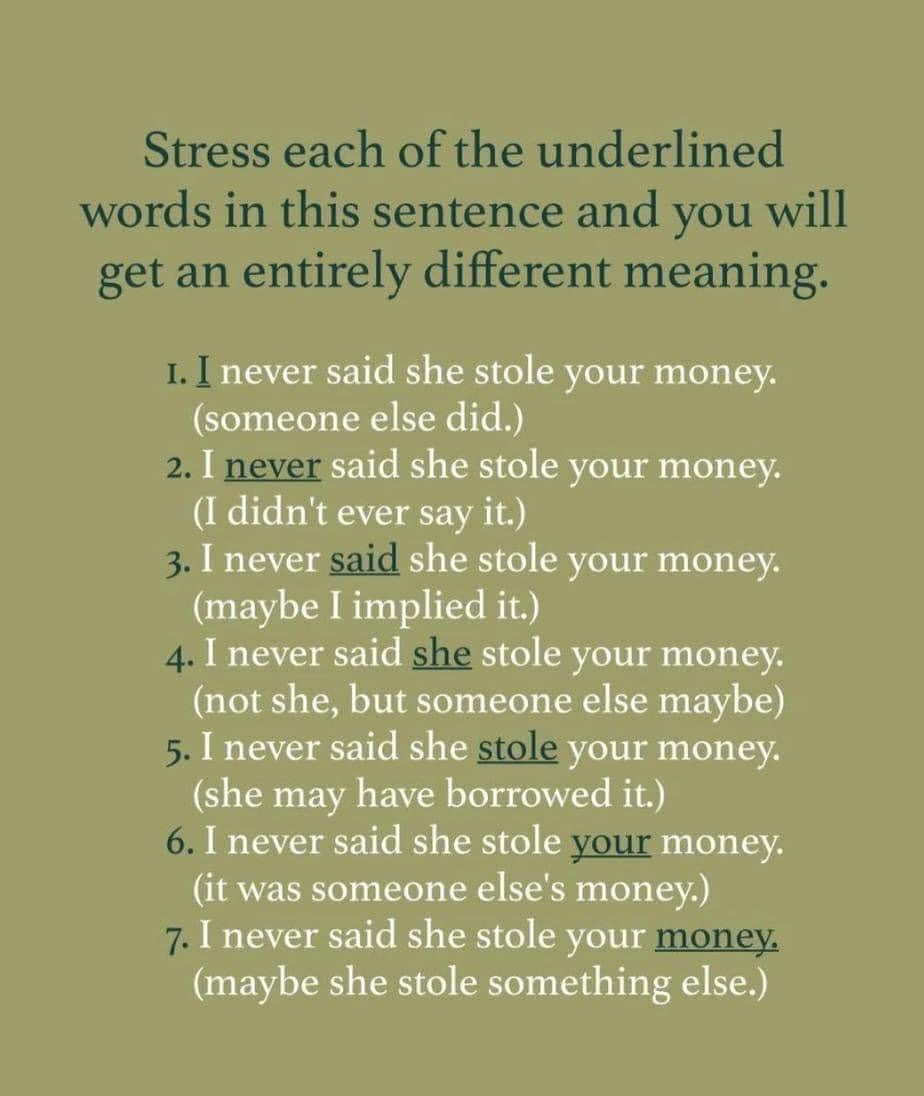
It seems wise to give the texter the benefit of the doubt and presume the most gracious inflection and meaning… at least until proven otherwise. 😇

A Seat at the Table
In May 2021, a high school graduation photo from Muskogee, Oklahoma, began circulating online. Madison Moore stood in the middle, wearing her cap and gown, with Pryce Jackson and Kyran English on either side. Her father explained the photo in one sentence: “These 2 fine young men have watched out and have been friends with my daughter since kindergarten.”
The internet did the math. Kindergarten to graduation is thirteen years.
Madison has Down syndrome, and beginning in kindergarten, she was included in general-education classrooms, a step her mother had advocated for. Being in a classroom is one thing. Feeling like she belongs there is another. Over the years, Pryce and Kyran made sure Madison had a seat at lunch, a friend to walk with her in the hallway, and a hand to hold on field trips whenever she wanted one.
What did thirteen years of showing up look like? Wonderfully ordinary.
Kyran remembered that Madison would often ask him, Pryce, or both of them to walk or sit with her. “And it was never a burden to us at all,” he said. Pryce described their role as a kind of big-brother role: looking out for Madison, making sure she was okay, and, in his words, “being that person our parents raised us to be.”
Being that person our parents raised us to be.
Pryce and Kyran did not wake up one morning in high school and decide to become exceptionally kind young men. They had been learning, little by little, what friendship looks like. Notice someone. Make room. Sit down. Walk together. Stay. By the time graduation came, those choices were simply part of who they were.
Madison’s mother said the boys did not see her daughter as “a kid with Down syndrome.” They saw their friend. She described their friendship as second nature… just kids who loved one another.
The support wasn’t one-sided, either. Kyran remembered a day in third grade when a bad grade left him feeling low… It was Madison who consoled him. She wasn’t simply the friend being looked after. She was a friend who knew how to show up, too.
A seat at the table. A friend in the hallway. Lunch together. The normal things.
…and that is exactly what the Heartside Framework means by Do the normal things. It really is that simple.
We can raise a generation that notices when someone needs them… that knows how to make room for someone on an ordinary Tuesday… and that keeps making room until kindergarten somehow turns into graduation.
Source: Genovese, D. (2021, May 30). “Oklahoma teens praised for friendship with student with Down syndrome, as graduation photo goes viral.” Fox News. The graduation photograph, credited to Sheila Chambers, appears with the Fox report.
https://www.foxnews.com/us/oklahoma-students-teen-down-syndrome

“Died” Is a Kind Word
Picture a kindergartner in an itchy funeral dress. All morning, the adults have been saying strange sentences. We lost your grandpa. He passed away. He’s in a better place. She is five, so she is doing five-year-old math…
Lost things get found.
People who pass by come back our way.
If the place is better, when will we go visit Grandpa?
No one is a bad guy. Nobody in that room was trying to confuse her.
We often reach for the soft words because we love our children, and the hard word feels like one more blow. Softening how we describe death is a kindness instinct… aimed, this time, at the wrong target.
The Heartside Framework takes a stand here:
Heartside Framework Action One:
“Say the true thing.”
Use honest words… even the hard ones.
“Died” is a kind word when it is said kindly.
Action One of the Heartside Five states: Say the true thing. At its core is the claim that gives this feature its name: “Use honest words… even the hard ones. ‘Died’ is a kind word when it is said kindly.”
The experts who spend every day with grieving children agree. Dougy Center*, the National Grief Center for Children & Families, teaches helpers to “use concrete words such as ‘died’” rather than “vague terms like ‘passed away.’” Their reason is not stylistic. Young children are concrete thinkers. In Dougy Center’s own example, a young child who hears “Dad passed away” or “I lost my husband” may quietly expect that his father will return… or simply needs to be found.
Euphemisms do not soften the death. They fog it. The child eventually learns what happened… but along the way, they also learn that some of the people they trust speak in riddles about some of life's biggest things. Honest words do the opposite. They make the enormous thing nameable, and naming a hard thing measurably calms the mind’s alarm rather than feeding it.** Best of all, the honest speaker gets marked in the child’s ledger as someone who can be asked anything and trusted with hard feelings.
When using true words, kindness is required in the delivery. “Died,” said gently, up close, with a hand on a small shoulder, is a world kinder than any euphemism offered from across the room. The word does the honesty. The voice does the love.
In practice it is mercifully simple. When the question comes, answer it straight and small: “Grandpa died. That means his body stopped working, and it can’t be fixed.” It’s okay if your voice shakes. It’s okay if you tear up.
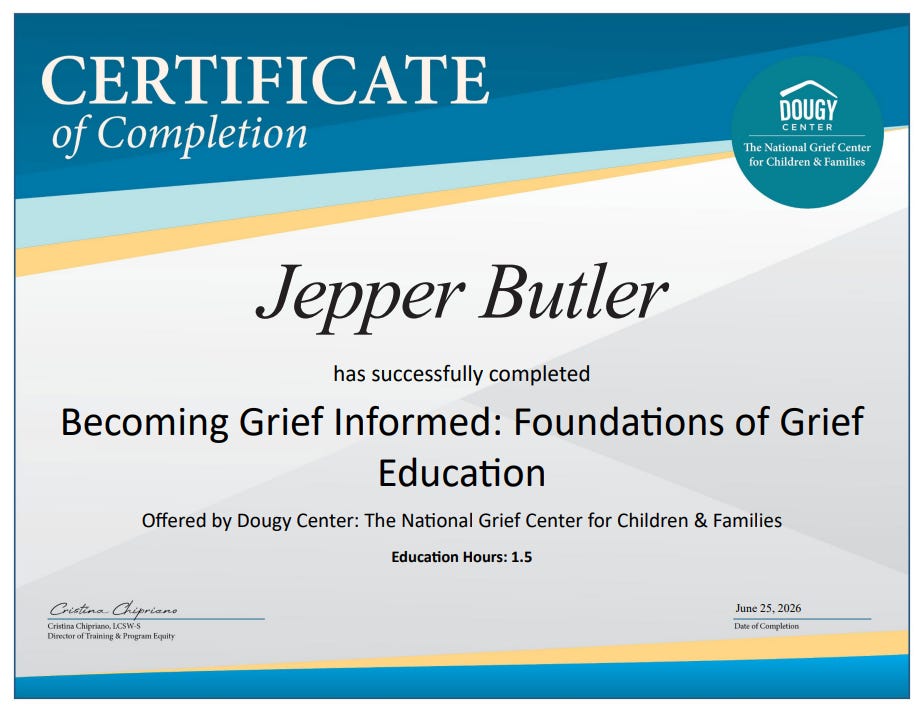
A word about Dougy Center, because this feature leans on their wisdom. From their home in Portland, they support grieving children, teens, and families, and they train helpers worldwide. Their free resources belong on every guide’s shelf. They also provide various training classes. I’ve taken their “Becoming Grief Informed” training myself, and I plan to take more. I support their mission wholeheartedly. Find them at dougy.org.
Somewhere ahead of you, a child is holding a hard question. You now know the kind answer is the true one.
Notes
* Dougy Center: The National Grief Center for Children & Families, “How to Help a Child Who is Grieving.” Dougy Resource Page
** Naming an emotion measurably quiets the brain’s alarm systems: Lieberman, M. D., et al. (2007). Putting feelings into words: Affect labeling disrupts amygdala activity in response to affective stimuli. Psychological Science, 18(5), 421–428. https://pubmed.ncbi.nlm.nih.gov/17576282/

Do the Normal Things
Consistently Ordinary
When someone we love is hurting, we tend to reach for something big. Flowers. The giant card the whole class signs. The perfectly worded message we rewrite eleven times… then send at midnight.
Or we do the opposite. We back away and give them space… respectfully, quietly, and from a distance.
Two instincts. Both rooted in kindness. Both can leave a hurting friend feeling strangely alone. If you have ever hovered near someone’s hard season, holding a casserole with no idea what to say, you know the two instincts can visit in the same afternoon.
Here is a third way… and it is almost embarrassingly small:
Do the normal things.
When something sad happens to a person, much of the familiar world can suddenly feel different. Ordinary things like the same seat, the same game, or the same walk home can become small anchors. They don't fix anything… they aren't trying to. They simply keep a little piece of the world recognizable while the hard part is hard. Research with children grieving the death of a parent has found that stability, positive relationships, and familiar routines can matter after a loss.* The ordinary parts of life can offer welcome steadiness when so much else has changed.
Try this: Ask a young person about a friend they care about. “What are the little, normal things you two share?” You’ll likely get a happy list… the game, the show, the snack trade, and the joke no one else finds funny.
Then discuss: If something sad happened to your friend, what might happen to all those normal things? Often, they stop. Everyone tiptoes, everyone pretends, or everyone starts looking for the big gesture. Go back to their list and ask…
“Which of those little things could you keep going anyway?”
There is no single right answer; that’s part of the beauty. The saved seat. The Tuesday game. The walk that still leaves on schedule. The answer only has to be small enough to happen… and steady enough to happen again.
That is the superpower little things have over grand gestures. A grand gesture asks once and goes home. A little thing can come back tomorrow.
It lands, like so much at the Heartside, on the Heartside Promise: “I don’t need to fix the sad. I just need to show up.”
Showing up, it turns out, often looks wonderfully unremarkable.
You might experience a side effect of this exchange...
You may start noticing the normal things in your own friendships differently. The coffee. The walk. The running joke. The Tuesday phone call. Ordinary things can look a little less ordinary once you realize what they can mean.
This seed is deliberately small. Want it fully fleshed out and ready to go... every age from 6 to 18, word-for-word language, and printables? This week’s premium Heartside Lesson Plan is done for you... and ready when you are:
* Haine, R. A., Ayers, T. S., Sandler, I. N., & Wolchik, S. A. (2008). “Evidence-Based Practices for Parentally Bereaved Children and Their Families.” Professional Psychology: Research and Practice, 39(2), 113–121. The review discusses empirically supported protective factors and intervention practices for parentally bereaved children, including stable positive family experiences, supportive relationships, and efforts to restore consistency and structure. Open access: https://pmc.ncbi.nlm.nih.gov/articles/PMC2888143/ DOI: 10.1037/0735-7028.39.2.113.

Grief Doesn’t Do Stages
Denial. Anger. Bargaining. Depression. Acceptance. You can probably recite them... nearly everyone can. For more than fifty years, classrooms have taught the five stages of grief, hospitals and counseling offices have discussed them, and the internet has shared them. They have become one of the best-known ideas about grief.
In 2017, three established bereavement researchers published a review posing a simple question:
After five decades, does the evidence support the five stages of grief?
The answer was “No.”
Studies following bereaved people over time revealed more variation than expected in the five stages of grief. One landmark project followed older adults from before a spouse’s death to well after. Nearly half (46 percent) showed a resilient pattern, with relatively low distress throughout. Only about 11 percent showed the rise-and-fall pattern that grief researchers had once assumed was common. That study did not test the five stages directly, but it offered strong evidence against the idea of a single normal path through grief.
Overall, the review concludes that grief is not stage-like, orderly, or predictable. It is fluid, overlapping, and different from person to person.
But the paper goes further than saying the stages do not fit the evidence:
Expecting people to follow the stages can actually do harm.
Some of that harm can come from well-intentioned helpers.
When we refer to a grief-stage map, we may start coaching people through it... nudging a friend toward “acceptance,” worrying when the anger never comes, or quietly wondering whether the grief in front of us is unfolding in the right order. The review warns that a mistaken belief in stages can leave bereaved people feeling as though they are not coping correctly… while shaping unhelpful responses from friends, family, and professionals. Supporters’ attention shifts toward where someone “should” be instead of the person actually in front of us.
A wrong map does not just mislead the traveler. It misleads everyone walking beside her.
This is why the Heartside Framework teaches actions, not stages. A Heartside Hero is never asked to figure out where a friend “is” in grief or to steer them toward the next stop. Heroes are taught what they can do in the moment in front of them:
Say the true thing.
Put the ball down.
Sit beside them.
Do the normal things.
Remember out loud.
The review also revealed some encouraging news. The researchers found that (instead of going through predictable stages) most bereaved people adjust to loss in their own way, drawing on their own resources and the informal support of family, friends, and community.
Those support people are exactly the ones Heartside exists to equip.
For now, the takeaway is simpler:
Let go of the map. Pay attention to the friend.
For the full walkthrough of this review... where the stages came from, fifty years of objections, and what the researchers recommend instead... see this issue’s Research… Explored:
Source: Stroebe, M., Schut, H., & Boerner, K. (2017). “Cautioning Health-Care Professionals: Bereaved Persons Are Misguided Through the Stages of Grief.” OMEGA—Journal of Death and Dying, 74(4), 455–473. Open access. DOI: 10.1177/0030222817691870.

She Saved My Life
When singer-songwriter Andy Grammer was 25, his mother died. His godmother, Leigh (his mother’s best friend), stepped into the enormous void left by her death and stayed.
Grammer said it plainly in an interview, saying she “really showed up for me to all the big and small life things.” Notice what he doesn’t claim. Nobody fixed his pain. Nobody made his mother’s death okay. No one could. What Leigh offered was presence, again and again. She was at the funerals, the birthdays, and the ordinary Tuesdays… for years.
More than a decade later, the world learned what that presence had been worth. In 2022, Grammer released “Saved My Life,” a soaring collaboration with producer R3HAB. The song’s chorus was aimed directly at Leigh: “I think you should know you saved my life.”
The official video widens the circle. Grammer invited fans to honor the people who showed up in their lives… teachers, parents, friends, and even strangers. The result is a parade of gratitude for heroes who never knew how much they mattered.
The Heartside Promise says:
You don’t need to fix the sad. You just need to show up.
“Saved My Life” is the view from the other side of that promise… from the perspective of the person who was hurting. Years later—long after the casseroles were gone and the sympathy cards had stopped. What did he remember? Not a speech. Not a fix. Someone who showed up. Someone who stayed.
None of what Leigh did was an accident. Showing up “to all the big and small life things” for years is not something a person stumbles into. It’s a decision… a decision made early and renewed on ordinary days. It’s exactly the kind of decision the Heartside Framework exists to prepare young hearts to make.
What Leigh could not see was the total impact… what all that ordinary presence was quietly adding up to.
That may be the most encouraging math in the whole song. The showing up is intentional. The saving is often invisible… sometimes for a decade, sometimes forever.
The world is full of hurting people. Show up. Teach others to show up. Show up for the big things. Show up for the small ones. You may never learn what that presence was worth. Leigh went more than a decade without knowing. Heroes show up anyway.
Sources:
Andy Grammer, quoted in “Andy Grammer Collaborates with R3HAB for Heartfelt New Single ‘Saved My Life,’” S-Curve Records, May 6, 2022. https://s-curverecords.com/andy-grammer-collaborates-with-r3hab-for-heartfelt-new-single-saved-my-life/
Andy Grammer and R3HAB, “Saved My Life,” Giant Soul/S-Curve/Hollywood Records, 2022. [official video link]

Mission > Conflict
Many thanks to Sherry Grote and Ryan Worley - Noble Ruins for your encouragement and support of the Heartside Project’s mission!
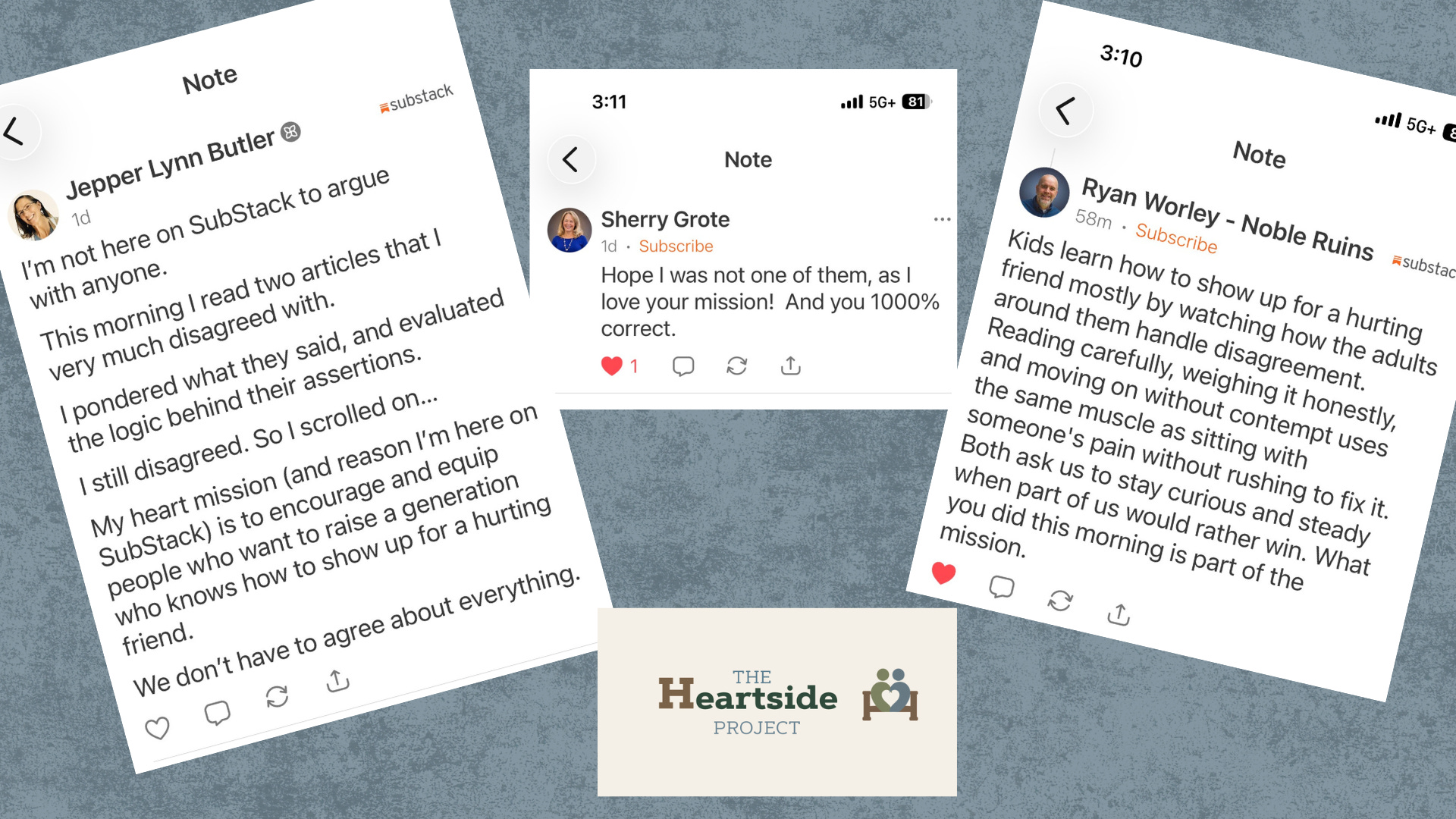
You’re right, Ryan… the kids are watching us and noticing how we interact with others. That’s an excellent point.
…and Sherry, neither article that I disagreed with was yours. But even if it was, I have no doubt that we could work well together supporting the Heartside mission. People don’t have to agree about everything to work together and make a difference!
Let’s raise a generation that knows how to show up for hurting friends.
See you next time… We’ll save you a seat.
Jepper Lynn
Aww thanks! Glad to know it wasn't me cause I agree with your mission so immensely! Love what you are doing here and how you are raising awareness to raise amazing humans!