


Birthday Bash Blur
Today, I’m enjoying the Labor Day holiday by recovering from a wonderfully chaotic weekend of grandson birthday gatherings.
On Saturday, my oldest son’s youngest four held a joint “Mega Birthday Bash” with backyard swimming and front yard inflatables. The birthday boys are turning (or have recently turned) 12, 10, 9, and 4.
Then on Sunday, we celebrated my #2 son’s oldest sons’ 10th and 8th birthdays. We drove a bit over three hours each way to the Nashville area for a gymnastics party (and an afterparty of swimming and socializing). We returned home (and to the Eastern Time Zone) in the wee hours of the morning.
I love my big, crazy family!

First Day Photo
Every August, the same picture is taken on porches and front steps across the country: a new backpack, new shoes, a kid squinting into the morning sun. In Manila, Arkansas, the Curtwright family had been taking that picture for years. It started with Brady, and when his little sister, Nora, was old enough, she joined him. Big brother, little sister, side by side. Nora even got a backpack to match his.
Last December, Brady died after a car accident.
He was fourteen. Nora was nine.
As another school year approached, their mom, Ashley, asked Nora if she was ready to go back. Nora said no. It wasn’t the new teacher or the new classroom that worried her…
“On my first day, who is going to take my picture with me?”
There are parts of grief that arrive when everyone expects them. Then there are the ones hiding in perfectly ordinary places: birthdays, ballgames, holidays, and first-day-of-school pictures. Ashley told Nora they would figure it out. She then asked Gabe Gonzales, Brady’s best friend since seventh grade, to take the picture with her. Gabe agreed, but he also had a bigger idea. He texted their group chat: “Who’s down to take a picture?”
They were all down.
On the first day of school, Nora carried a picture of Brady. As she and her mom walked through the doors toward her new middle school, twelve of Brady’s friends were waiting. The picture was taken, not because twelve boys could replace one brother. They couldn’t. Ashley knows that better than anyone. She told KAIT that the boys would never fill the void Brady left, but that they had become family because of how much they loved him. They did something else instead: They showed up.
That matters… because the hardest days of grief aren’t confined to the first few weeks. They are scattered across the calendar: a first day, a birthday, the opening game, an old tradition that suddenly feels very different. Showing up for a grieving friend often means remembering those days, too.
A few weeks later, Nora told People what she thought when she saw the boys waiting for her: “When I saw them, I knew I was going to have a good day.” More than that, their presence told her something bigger. If she needed them, she knew they would be there. She expects them back for next year’s picture, too. “They are always there,” she said.
That’s what Heartside Heroes do. The boys didn’t make Brady’s absence disappear. They didn’t try to make Nora less sad about missing her brother. They simply made sure that when one of those hard dates came around, she didn’t meet it alone. Gabe says there will be more pictures.
Nora asked who was going to be there. Twelve boys answered.
KAIT Region 8 News, "Brady's friends show up for his little sister's first day of school," Alejandra Hernández, August 12, 2026. PEOPLE, "After Big Brother's Death, 9-Year-Old Girl Worried Their First-Day-of-School Ritual Was Ruined. Then His Friends Showed Up," Brian Brant, September 1, 2026. Video: KAIT Region 8 News, via YouTube.

The Hands Remember
Quick test: Try to say the words to “The Itsy Bitsy Spider” without moving your hands.
Go ahead. We’ll wait. 🕷️
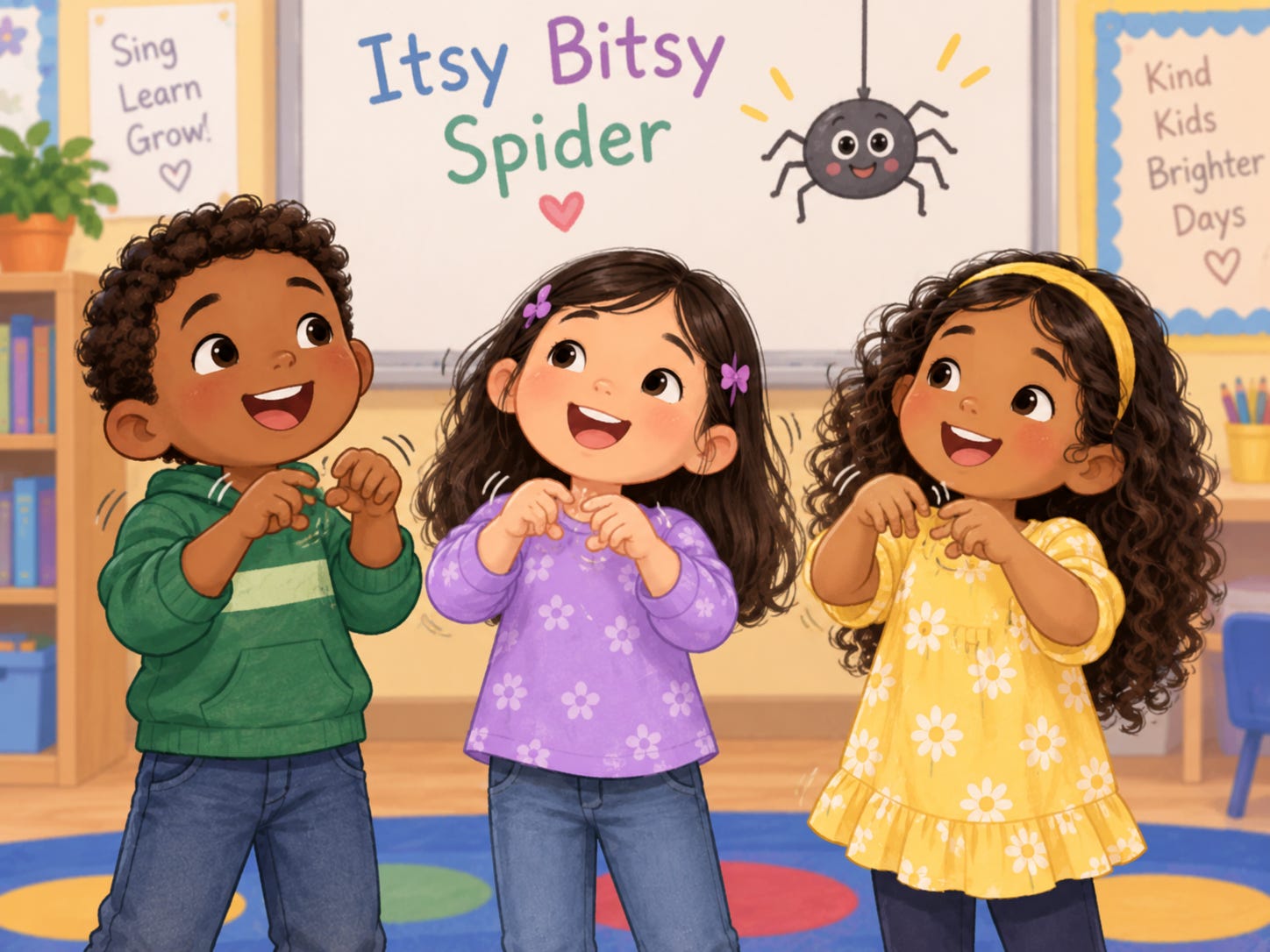
If your fingers started climbing the waterspout on their own, you’ve just encountered the oldest teaching trick in the world. Nobody drilled you on that song. You did it… and decades later, the words and motions are still filed together, hands first. Bodies keep things in a deeper drawer than words can reach. The Heartside Framework is designed to be filed in that drawer.
We teach our Heartside Framework on the hand. When a class or a family learns the framework, they don’t just hear it… they do it:
The Heartside Promise is said with an open palm, where it lives: “I don’t need to fix the sad. I just need to show up.”
Then the Heartside Five are counted on the fingers: pointer for Say the true thing, add the middle finger for Put the ball down, and so on until Remember out loud opens the whole hand. (Always the running count, never one finger at a time… finger number two, flying solo in a fourth-grade classroom, teaches a lesson nobody planned.)
The Backup Rule gets a high five because calling for backup should feel like a win… and the high five symbolizes the helping hand of a trusted adult.
The ritual always ends where the framework begins… hand over heart, the Heartside Promise one more time. Children have watched adults make hand-on-heart pledges their whole lives. They know exactly what it means.
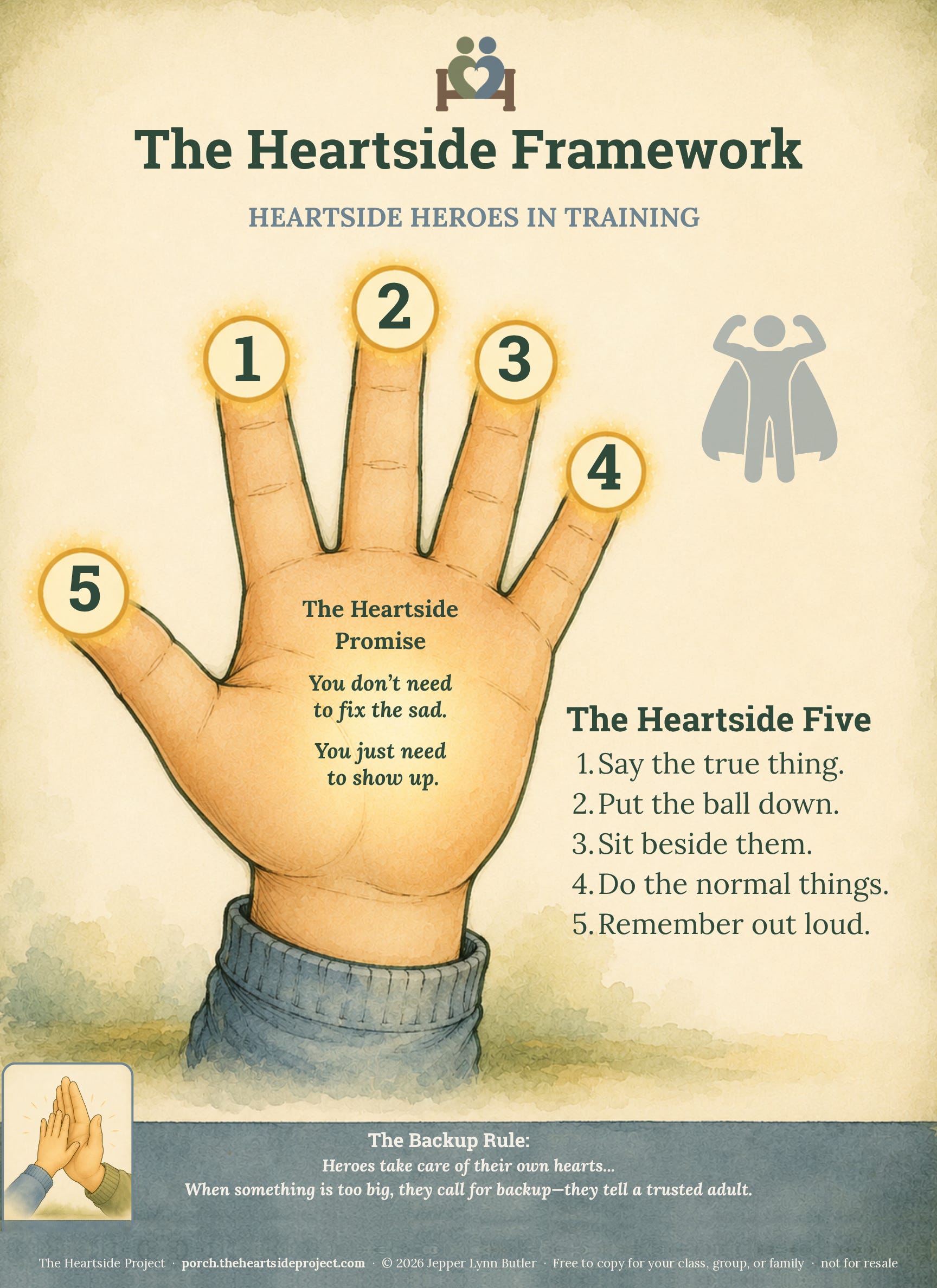
Leading it takes no talent and ten seconds. Model it slowly once. Then do it together… same order, same words, at the start and end of every lesson, until their hands run it before their mouths catch up.
Memory researchers call it the enactment effect: People remember what they physically do far better than what they only hear or read.*
As a former (…but always in my heart) math teacher, I especially appreciate this study:
Researchers taught 84 third- and fourth-graders a math concept… some children repeated only the words; others added gestures. Four weeks later, the children who gestured retained nearly everything they’d learned. The speech-only group retained about a third. The researchers concluded that “One way to promote lasting change in children’s minds may be to change what they do, rather than what they say.”**
Fair is fair: None of this research studied grief. It studied learning… but the information still applies. Hands don’t ask what the learning is for.
We’re not teaching math (sad, I know). But someday a Heartside Hero’s friend will be crying, and that Hero’s mind will go blank. Minds do that—but hands don’t forget as easily. That Hero’s hands will know a reassuring promise, five actions to try, and where to reach for backup.
*Madan, C. R., & Singhal, A. (2012). Using actions to enhance memory: Effects of enactment, gestures, and exercise on human memory. Frontiers in Psychology, 3, 507. Open access: doi.org/10.3389/fpsyg.2012.00507
**Research notes: Cook, S. W., Mitchell, Z., & Goldin-Meadow, S. (2008). Gesturing makes learning last. Cognition, 106(2), 1047–1058. Free full text: pmc.ncbi.nlm.nih.gov/articles/PMC2265003

Sit Beside Them
Quiet Comfort
Every adult knows the moment. A friend is sad. We’ve said everything we can think of. The conversation runs out of road… the quiet arrives.
In a very short time, silence can feel oddly loud. Ten seconds of it… and it feels as if the whole room is staring at you. Researchers have measured it: In one experiment, a four-second pause in a conversation was enough to stir unease.*
So we often choose the easiest escape from the discomfort… suddenly remembering somewhere we need to be. We leave the friend alone in their sadness. We’re not being unkind. It’s just… the silence feels like proof that we are failing. No words left must mean no help left, right? Wrong.
Children will naturally do the same thing. Picture this playground scene: A sad kid on the bench, a friend who hovers, runs out of things to say… then drifts back to the swings. The adult version looks different (we don’t spend much time on playground benches), but it follows a similar pattern in hospital hallways, funeral lobbies, and with the casserole left on the porch without knocking. We care. But nobody ever taught us what to do when the words run out.
Here is an idea worth trying with the young people in your life. Talk about the two kinds of quiet:
The first kind is the quiet of an empty room… no one there, nothing happening. The second is the quiet of someone sitting close… someone who isn’t going anywhere. If you’ve ever fished with someone or ridden home from a long day with a loved one, you’ll recognize the second. It’s the same silence, but a different feeling. Think about it. Have you experienced both? How can you tell them apart?
Then think about the harder one: If your friend was too sad to talk, what could the two of you do together that needs no words at all? Let the ideas come. Some will be wiggly. Some will be wonderful. All of them are the point.
Somewhere in that conversation, a young person discovers something many adults never did: You don’t need to fill the quiet. You just need to stay in it. Nothing gets fixed. The sadness doesn’t magically go away. The sad friend simply stops being alone in their sadness… and that makes a BIG difference.**
That brings us back to the Heartside Promise: You don’t need to fix the sad. You just need to show up.
Sometimes showing up simply means not leaving.
This seed is deliberately small. Want it fully fleshed out and ready to go... every age from 6 to 18, word-for-word language, and printables? This week’s premium Heartside Lesson Plan is done for you... and ready when you are:
*Even a four-second silence dropped into a conversation lowered feelings of belonging and raised feelings of rejection, below conscious notice: Koudenburg, N., Postmes, T., & Gordijn, E. H. (2011). Disrupting the flow: How brief silences in group conversations affect social needs. Journal of Experimental Social Psychology, 47(2), 512–515.
**The simple nearness of someone who cares measurably calms the brain’s threat response: Coan, J. A., Schaefer, H. S., & Davidson, R. J. (2006). Lending a hand: Social regulation of the neural response to threat. Psychological Science, 17(12), 1032–1039.

Hero Is a Hard Job
Somewhere in Denmark, a teenager’s phone rang. It was her best friend, crying so hard she could barely be heard: “My father died tonight.”
What that girl did next was the beginning of a long, difficult journey.
Researchers at Aarhus University interviewed ten young women who, as teenagers, supported a best friend after a parent died. Not the grieving children… the friends who showed up and stood beside them. All ten stayed. All ten struggled.
They didn’t know what to say… nobody had taught them.
They tried to fix things by cheering their friends up… and failed.
They feared the wrong word would restart the grief… so they stayed silent.
They hid their own troubles… staying strong at funerals, then crying in private.
They gave and gave. “It truly is [exhausting] to just give,” one remembered. “But that is what you do. It is part of the deal.”
Despite the challenges, the researchers did not recommend shielding young people from the job of supporting a grieving friend. Instead, they recommended telling them the truth about it. The researchers conclude that making it clear that supporting a grieving friend is a challenging, long, difficult job “may enable even more friends in succeeding.”
Why would that help? Because these friends weren’t short on love. They were short on preparation. No one told them that their friends’ withdrawal was normal, that the fix-it urge would fail, or that needing their own backup wasn’t a weakness. A hard job becomes easier to survive when someone gives you honest expectations… and then stays close as you do it.
This is why the Heartside Framework calls them Heartside Heroes. Not because it’s cute. Because the job is hard, and hard jobs require training before the alarm sounds and the call goes out… not after. Tell the young people in your life the truth: Showing up for a hurting friend is hard work. Teach them what to expect. Then be their backup while they do it.
One of the heroes interviewed received her reward in a single sentence… her grieving friend simply said, “Thank you for being here.” That acknowledgment was enough to keep her going.
The full walkthrough of this study: twelve themes, drawn from the young women’s own words, is in this issue’s Research… Explored section:
Source: Winther-Lindqvist, D. A., & Larsen, I. O. (2021). “Grief and Best Friendship Among Adolescent Girls.” OMEGA—Journal of Death and Dying, 83(3), 545–562. First published online in 2019. DOI: 10.1177/0030222819856146.

What the Rabbit Knew
The Rabbit Listened, written and illustrated by Cori Doerrfeld

Taylor builds something from blocks… “something new, something special, something amazing.” Then a flock of birds crashes through, and it’s gone.
What happens next may be the truest picture of showing up we’ve found in a picture book.
The animals arrive one at a time, each carrying a fix. The chicken wants to talk about it. The bear wants to shout about it. The elephant wants to remember exactly how it was and rebuild it. The hyena wants to laugh it off. The ostrich wants to hide from it. The kangaroo wants to sweep the whole mess away. The snake wants to go knock down somebody else’s.
Think about the animals in the parade... Not one of them is unkind. Every single one shows up… briefly. Each offers the comfort that works for them: their move, their medicine, their fix. When Taylor doesn’t want it, each one leaves. They came to fix, so when the fixing was refused, there was nothing left to stay for.
Taylor is alone.
Then the rabbit comes. The rabbit doesn’t propose anything, perform anything, or try to fix anything. The rabbit simply moves closer… a warm body, quietly beside. Taylor is the one who finally speaks: “Please stay with me.” So the rabbit stays. The rabbit listens.
Then something amazing happens... With the rabbit nearby, Taylor does nearly everything the parade proposed. Taylor talks, shouts, laughs, remembers, plans to hide, and even briefly dreams of wrecking somebody else’s day. Every feeling gets its turn. In Taylor’s order. At Taylor’s pace. Out loud to somebody safe. The animals weren’t wrong about the feelings. They were wrong not to give Taylor the space to choose the action and the timing.
Hurting hearts don’t take their feelings on a schedule. But when someone stays close and quiet, the feelings find their own way through. By the last page, Taylor is planning to build again: “It’s going to be amazing.”
If you’ve been learning the Heartside Framework, you can probably name everything you just watched:
Every fix in that parade is a ball… and the animals didn’t know how to put their balls down.
The rabbit goes straight to sit beside them… and the listening makes room for Taylor to say every true thing there was to say.
Underneath the whole book beats the Heartside Promise: You don’t need to fix the sad. You just need to show up.
Read it with a child you love. Then think about it together: Which animal shares your fix? Everybody has one. Me? I tend to be a mix of the chicken and the elephant. I want to talk, to encourage, to look at the bright side, to make a plan to rebuild… But I, too, am learning to put my balls down.
The rabbit seemed to do this naturally. But we can teach our children.
The Rabbit Listened, by Cori Doerrfeld (Dial Books for Young Readers, 2018).

The Back Porch Title
I’m blown away by the positive support that I am getting from new followers and subscribers. Thank you!
If you have an idea for one of the features or have a personal Heartside Hero story, we’d love to hear [and possibly share] it.
Let’s raise a generation that knows how to show up for hurting friends…
See you next time… We’ll save you a seat.
Jepper Lynn