



Porch Ponderings
Hello, Jepper here. 👩🏻💻
Welcome! The front porch of my house is where I greet guests and welcome friends. It’s also where I sit to learn of neighborhood happenings, enjoy thunderstorms, read a good book, and ponder God’s goodness. It’s a place to gather information—but it’s also the place where I can relax and just be… me.
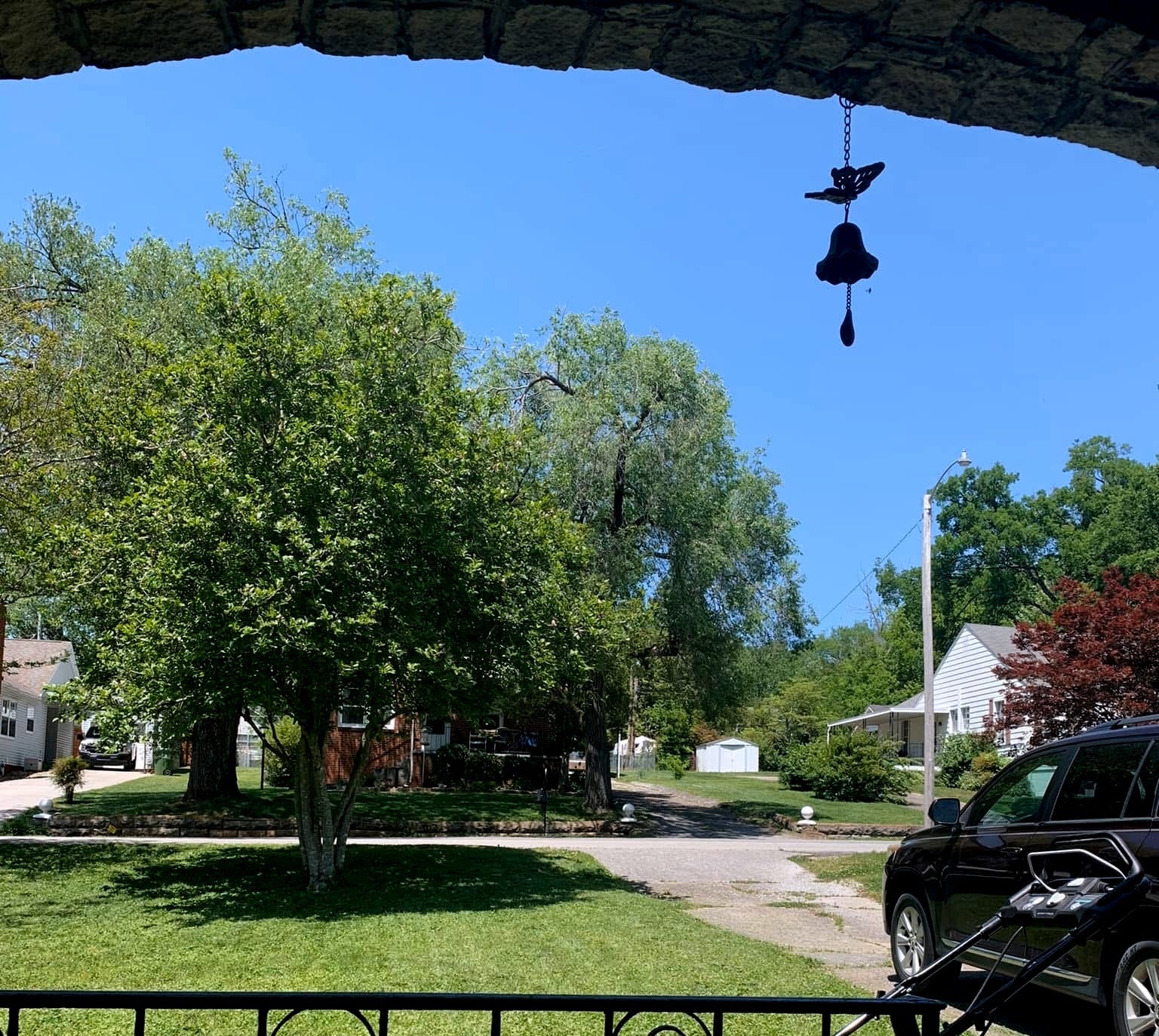
That’s how I view the Front Porch of Heartside Magazine… and the kind of thing I plan to share in this space. The Front Porch is where you’ll see glimpses of the world through my eyes. I’ll update you on new projects (like this first issue of Heartside Magazine), holiday happenings, personal opinions, and possibly even announcements of new grandchildren… (I currently have sixteen. Yes, 16!)
But most of Heartside Magazine is dedicated to The Heartside Project’s mission—to encourage and equip caring adults who want to raise young people who know how to show up for hurting friends.
Pull up a chair and join us…

The Boy Who Didn’t Walk Past
The first day of school has a personality all its own.
The hallways are louder than they need to be. Backpacks somehow seem bigger than the children carrying them. Teachers are smiling, parents are smiling… and if we’re being honest, quite a few of those smiles are more forced than real.
For one eight-year-old boy named Connor, it was simply too much. He stepped away from the crowd, found a quiet corner, and cried.
Christian, another second grader, noticed him.
Christian didn’t know why Connor was upset. He didn’t know Connor was autistic. He didn’t know if they would someday become friends or if they’d even talk again after that morning.
What he did know was that no one should have to cry by themselves.
So he walked over… and sat on the ground beside the crying boy. No speeches. No clever advice. No attempt to make the first day of school suddenly feel easy. Just two boys sitting together for a little while.
When the bell rang, Christian reached for Connor’s hand, and they walked into school together.
Christian’s mom happened to capture the moment in a photograph that she later shared online. The internet did its thing, and the picture eventually found its way to Connor’s mom, who thanked Christian for the kindness and shared that Connor is autistic.
It’s a beautiful story: An eight-year-old saw another child hurting and didn’t keep walking.
That kind of kindness doesn’t happen by accident. Most kids (and honestly, most adults) avoid the awkwardness of not knowing the “right thing” to do by simply walking by. But somewhere along the way, Christian learned that you don’t need all the answers before you step toward someone who is hurting.
…you don’t need all the answers before you step toward someone who is hurting.
Later, Connor was asked what he remembered about that morning. His answer? “He found me and held my hand.”
Found me. I love that.
Not, “He fixed everything.” Not, “He made me stop being scared.”
Just… He found me.
Then Conner added one more detail. “…and I got happy tears.” Happy tears. On the hardest morning of the year.
We don’t need to know exactly what to say. We don’t need to make the hurt disappear. We don’t even need to understand everything someone is going through—but we shouldn’t walk past.
Christian didn’t try to fix the sad. He simply showed up.
…and on one chaotic August morning, that was enough.
*As reported by CBS News, ABC News, and KSL, August 2019. Both families shared this story publicly.

The Whole Thing Fits in Your Hand
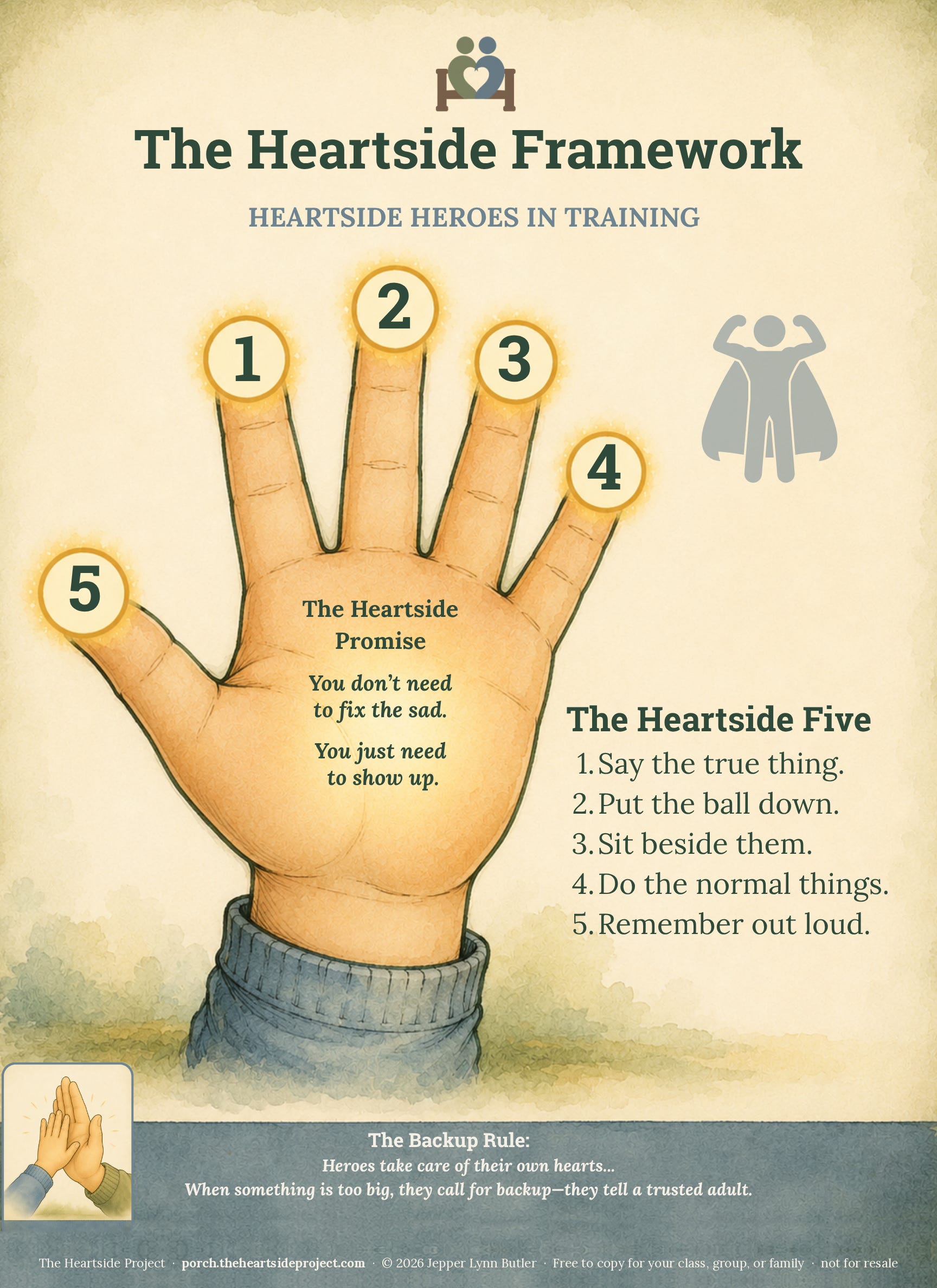
Since this is our first issue, let’s start at the beginning... and the beginning is good news: Children can learn to love a hurting friend well. The skills are small, they are learnable, and they fit... quite literally... in the palm of a child’s hand.
Each week, we’ll dig into some aspect of the Heartside Framework, our research-informed framework for teaching young people (and often the adults around them) how to show up for a friend whose world just got heavy.
But first… what this is NOT. This is not a program for grieving children or a therapy manual. The Heartside Framework is for the friend standing at the edge of the sadness... the place where most of us [youth and adults alike] freeze. Our kids don’t have to inherit that.
It starts with a promise
Everything rests on one sentence, right in the middle of the palm:
You don’t need to fix the sad. You just need to show up.
The fear that keeps children away from a hurting friend is almost never a lack of love. It is the belief that showing up means fixing... and since nobody can fix the sad, everybody stays home. The Heartside Promise takes that job off the table. Children learn it in their own voice: “I don’t need to fix the sad. I just need to show up.” Once a child believes that sentence, the hardest part is done.
Then come the five actions
Showing up is made of five small, doable actions... the Heartside Five. Children count them on their fingers, starting with the pointer:
Say the true thing. There are no magic words... There are true ones.
Put the ball down. The urge to cheer up, distract, and fix is the ball. Set it down.
Sit beside them. Presence… not answers. Being there is the whole job.
Do the normal things. The ordinary world is still here. Keep gently inviting your friend into it.
Remember out loud. Say the name. Tell the stories. That is how the love keeps going.
Smile. This isn’t somber work. It’s empowering work. It’s hero work. Heroes should feel good about it.
One rule keeps everyone safe
The last piece belongs to another hand… a trusted adult’s.
We call it the Backup Rule:
Heroes take care of their own hearts...
When something is too big, they call for backup—they tell a trusted adult.
Firefighters call for backup. Police call for backup. Heroes do too... it is not tattling, and not failure. Make sure your Heartside Heroes understand this.
Where to begin
Each issue, this feature will go deeper into a piece of the framework. If you’d like to teach the whole-hand overview this week, the Foundation lesson, “Becoming a Heartside Hero,” is ready for you. Like all premium Heartside Lesson Plans, it includes adaptations for ages 6 to 18, fits into your schedule (running between 10 minutes and 45 minutes with a 20-minute base time), includes downloadable tools, and more. → Heartside Framework Foundation Lesson.
They don’t need to fix the sad. They just need to show up.
…and now you know how to teach them.

Say the True Thing
There are no magic words that will fix everything for a sad friend. That’s the obvious secret... and once your kids know it (and accept it), everyone is free.
Try it at the dinner table or during circle time. Ask, “When a friend is very, very sad, what are the magic words that make it all better?” Let everyone guess until the guesses run out. Then share the secret: Nobody has magic words. Not kids. Not teachers. Not parents. Nobody. But we don’t need magic words... We need true ones.
Teach the One True Sentence: “I heard about ___. I’m really sorry. I’m here.” Practice it around the table with a pretend sad thing (a lost game, a dropped ice cream cone) until everyone has said it out loud once. Two rules while you practice: 1) No saying “at least” allowed. “At least” is a cheer-up phrase wearing a costume. 2) No hiding in silence.
Saying nothing protects our comfort at our friends’ expense.
Ouch!
If your crew is ready for one step deeper, talk about the word “died.” Adults often reach for vague, mushy words like “passed away,” “lost,” or “went to sleep” because they feel softer. To a child, that very vagueness can be scarier than the truth. True words communicate clearly: “Your dog died. I’m really sorry.” Teach your kids that “died” is a kind word when it is said kindly. Sad things are less frightening when there is no ambiguity. Say the true thing.
Then add the part most lessons skip… the staying. Practice a round of Say It and Stay. One person shares a pretend sad thing; their partner says a true thing, then stays for a slow count of five. No fixing—no filling the quiet. Five seconds feels very long the first time, and that is exactly the lesson. The words open the door, but the staying is what does the loving.
Here’s how you can make it stick… Hand out index cards. Everyone writes the One True Sentence, decorates it, and tucks it where they’ll find it on a hard day… a backpack pocket, a lunchbox, or a wallet. Yes… You too. Planning (and practicing) what to say is good practice for adults, too.
Say this: “Don’t worry about finding the perfect thing to say. Say a true thing... then stay.”
The heart of it: This is “Action One” of the Heartside Five: Say the true thing.
Want it fully fleshed out and ready to go... every age from 6 to 18, word-for-word language, and printables? This week’s premium Heartside Lesson Plan is done for you... and ready when you are: Lesson 1: Say the True Thing

The Committee Votes No
There’s someone that you’ve been meaning to check on.
You think about it more than once. Then, the committee in your mind convenes: She’s probably too busy. I don’t want to bother him. They wouldn’t care. What would I even say? The committee votes no. The committee always votes no.
In 2022, Peggy Liu of the University of Pittsburgh and three colleagues went looking at what happens when the committee gets overruled. Thirteen preregistered studies. Just under six thousand people. Someone reached out to a person in their life with something small… a note to say hi or a little gift. Cookies. Coffee. One mini plant. Every sender first guessed how much it would be appreciated. Then the researchers went and asked the receivers what they thought.
Senders guessed low. Thirteen studies... and they all guessed low. Receivers appreciated the reach-out more than the senders had predicted.
Then comes the curious part... The looser the tie, the more the sender’s guess missed. For general friendly acquaintances, the underestimation more than doubled. Notice what that does and doesn’t say. Your closest people still appreciate hearing from you the most. But the friendly-not-close ones are where your guess goes furthest astray. This means the people your committee feels most certain about are the people it understands least.
Someone thought of me.
While you debate what to write or what to gift, you grade yourself: Is this awkward? Is it a good time? Is “thinking of you” enough? But nobody on the other end is holding a rubric. Instead, they feel warm and think one uncomplicated thing: “Someone thought of me.”
This reminds me a bit of the Heartside Promise: You don’t need to fix the sad. You just need to show up. Nobody in those thirteen studies tried to fix anything. They sent a note. They handed over cookies. They showed up. The impact was greater than they expected.
These were ordinary people in ordinary weeks. No funeral, no diagnosis, no packed-up house, no marriage coming apart. Now, this study doesn’t address what a check-in is worth to someone whose world just fell apart. But what it can tell us is that our arithmetic is broken in the easy case—and badly. If we are this wrong on an ordinary Tuesday with a friendly acquaintance, we shouldn’t be trusting that same faulty math on the hardest day of someone’s life... not when other researchers have already found that the silence of friends is one of the loneliest parts of grief.
Now reach out. Yes, to that person who came to mind as you read that first sentence... Just a simple, “I’ve been thinking about you.”
Then hand it down. The next time your child stalls at the edge of a hurting friend? Tell her that scientists went and checked, and the person receiving it will appreciate it more than she thinks.
Want to walk through the whole study... how each of the thirteen experiments worked, why surprise is the secret ingredient, and where the honest fine print lives? This week’s premium Research… Explored, “The Reach-Out Gap,” is waiting for you here: The Reach-Out Gap
Study: Liu, P. J., Rim, S., Min, L., & Min, K. E. (2022). The surprise of reaching out: Appreciated more than we think. Journal of Personality and Social Psychology. Full paper.

What Sadness Knew
This issue’s Lens: Inside Out (Pixar, 2015)... the scene where the wrong emotion turns out to be the right friend.
Halfway through Inside Out, a candy-crying imaginary friend named Bing Bong loses the last thing he had left of his girl, Riley... his rocket wagon, swept over the edge into the memory dump. He sits down in the middle of the journey and will not move.
Joy gets to him first, and Joy does what we all do. Funny faces. Tickling. A game. Promises of fun up ahead. It is the whole cheer-up playbook, run by the most likable character in the movie... and none of it works. Bing Bong doesn’t budge.
Then Sadness sits down beside him. Watch what she does, because in about ninety seconds she runs four of the Heartside Five. She says the true thing: “I’m sorry they took your rocket. They took something that you loved.” She never once argues him out of his sadness... no “at least,” no silver linings... the ball stays down. She stays beside him and lets the quiet be quiet. Then she opens the door to remembering out loud, asking about Riley... and Bing Bong pours out the story of the day they flew back in time and had breakfast twice. “We were best friends.” “Yeah,” says Sadness. “It’s sad.” He cries. He leans on her shoulder. Then he stands up: “I’m okay now. Come on... the train station is this way.”
What the scene gets right is almost every action that the Heartside Five teaches: say the true thing (1), put the ball down(2), sit beside them(3), remember out loud(5). Notice, too, who does it. Not the bubbly friend with the best intentions, but the one our culture tries to suppress. Pixar hands the rescue to Sadness. Comfort doesn’t come from making the sad go away. It comes from making the sad person less alone. The final Heartside Five action sneaks into the end of the clip. After someone truly sat with him, Bing Bong found the train station himself. The normal world was still there, waiting for him to do the normal things(4)... when he was ready. Showing up was enough until he was ready.
Scene from Inside Out (Disney·Pixar, 2015), written by Pete Docter, Meg LeFauve, and Josh Cooley. Quoted briefly for commentary, with admiration.
Try it at your house. Watch the clip together, then discuss two questions: What did Joy try? What did Sadness do? Even young children can see it... and once they can see it, they can do it.

First Issue Wrap-Up
That’s it… The first issue of Heartside Magazine is complete. Now comes your part. (I’m talking to you. Yes, you… the one reading this.) Let me know what you really think. Too short? Too long? Which section was your favorite? Do you have a scene from a movie or television show that would be perfect for Heartside Lens? Do you have a personal Heartside Hero story to share? Let me know what you think. This mission cannot be accomplished on my own… It’s too big. So I value your support and input.
Let’s raise a generation that knows how to show up for hurting friends.
See you next week… We’ll save you a seat.
Jepper